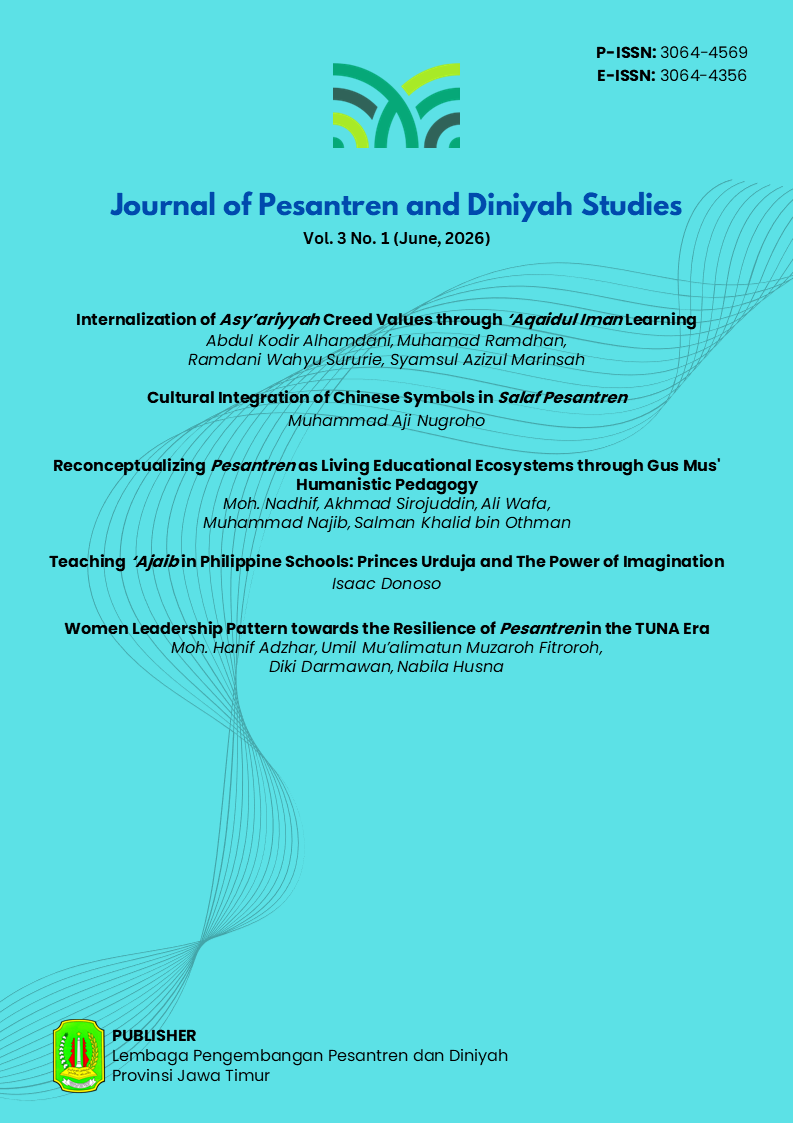
Cultural Integration of Chinese Symbols in Salaf Pesantren
DOI:
https://doi.org/10.63245/jpds.v3i1.71Abstract
This study is motivated by the presence of Chinese-style architecture at Pondok Pesantren Annasiha Salatiga, which continues to preserve the traditional salaf pesantren educational system and Javanese santri culture. This phenomenon reflects a unique cultural encounter between Islam, Javanese tradition, and Chinese culture within the educational space of the pesantren. The study aims to analyze the symbolism of Chinese architecture, the construction of Javanese identity, and the practice of religious moderation within the pesantren environment. This research employs a descriptive, qualitative approach, drawing on the perspectives of cultural anthropology and architectural semiotics. Data were collected through observation, in-depth interviews, and documentation, and were analyzed using the interactive model of Miles and Huberman, including data reduction, data display, and conclusion drawing. The findings indicate that Chinese architectural elements, including curved roofs, Chinese-style gates, ornaments, and symbolic colors, are reinterpreted within the Islamic and Javanese traditions of An-Nasiha Salaf Pesantren. Their integration with Javanese cultural values fosters cultural acculturation, multicultural awareness, tolerance, and religious moderation, contributing to the formation of an inclusive and adaptive Islamic identity. This study recommends further development of pesantren studies focusing on cultural perspectives and architectural symbolism as part of broader discussions on Islam Nusantara and multicultural Islamic education.
Keywords:
Chinese Architecture, Islam Nusantara, Javanese Identity, Multicultural Islamic EducationReferences
Alam, M. Bagus Sekar. “Acculturation of Java and Chinese Culture in Historical Perspective.” Sinolingua: Journal of Chinese Studies 1, no. 1 (March 2023): 1–14. https://doi.org/10.20961/sinolingua.v1i1.68944.
Arita, Arita, Hartanto Budiyuwono, and Yuswadi Saliya. “Acculturation of Local and Non-Local Architecture on the Scoping Elements of the Merah Panjunan Mosque Building in Cirebon.” ARTEKS : Jurnal Teknik Arsitektur 6, no. 2 (August 2021): 295–304. https://doi.org/10.30822/arteks.v6i2.755.
Ayuningrum, Diah. “Akulturasi Budaya Cina Dan Islam Dalam Arsitektur Tempat Ibadah Di Kota Lasem, Jawa Tengah.” Sabda: Jurnal Kajian Kebudayaan 12, no. 2 (December 2019): 122–35. https://doi.org/10.14710/sabda.12.2.122-135.
Barthes, Roland. Mythologies. New York: Hill and Wang, 2012.
Basiroen, Vera Jenny, and Ida Bagus Kerthyayana Manuaba. “The Culture Aspect of Javanese and Chinese Acculturation In Lasem.” Humaniora: Journal of Indonesia Culture and Society 13, no. 2 (May 2022): 91–97. https://doi.org/10.21512/humaniora.v13i2.7527.
Denzin, Norman K., and Yvonna S. Lincoln, eds. The SAGE Handbook of Qualitative Research. SAGE Publications, 2018.
Faoziah, Niswatin, Hasan Mahfudh, and Rima Ronika. “Religion and Multiculturalism at Pesantren Sunan Pandanaran and Mu’allimin Yogyakarta.” Al-Albab 5, no. 1 (August 2016): 3–29. https://doi.org/10.24260/alalbab.v5i1.352.
Fauzi, Muhammad Latif. “Traditional Islam In Javanese Society: The Roles of Kyai and Pesantren in Preserving Islamic Tradition and Negotiating Modernity.” JOURNAL OF INDONESIAN ISLAM 6, no. 1 (June 2012): 125–44. https://doi.org/10.15642/JIIS.2012.6.1.125-144.
Firmansyah, Irja Putra Pratama, and Munir. “Symbolic Meanings in the Social Interaction of Santri in the Pesantren Environment.” Al-Hayat: Journal of Islamic Education 8, no. 3 (October 2024): 1086–102. https://doi.org/10.35723/ajie.v8i3.698.
Gunawan, Ahmad Nur Sheha, Niken Laksitarini, Aris Oktaviani, Febrina Amalia Nur Aqmarina, and Ikhwanuddin Haran. “Akulturasi Arsitektur Bangunan Cina Pada Masjid Agung Sang Cipta Rasa Cirebon.” Besaung : Jurnal Seni Desain Dan Budaya 8, no. 2 (September 2023): 162–67. https://doi.org/10.36982/jsdb.v8i2.3289.
Hakim, Lutfi. “Pesantren Dan Pluralisme: Analisis Peran Pesantren Sebagai Katalis Pribumisasi Islam Di Indonesia.” JOIES (Journal of Islamic Education Studies) 6, no. 1 (June 2021): 49–69. https://doi.org/10.15642/joies.2021.6.1.49-69.
Hamzah, Rofiq. “Arus Balik Pesantren: Reharmoni Pesantren Dan Kebudayaan Jawa.” Tashwirul Afkar 40, no. 2 (December 2021). https://doi.org/10.51716/ta.v40i2.39.
Herdiansyah, Herdis, Hadid Sukmana, and Ratih Lestarini. “Eco-Pesantren as A Basic Forming of Environmental Moral and Theology.” Kalam 12, no. 2 (2018): 303–26. https://doi.org/10.24042/klm.v12i2.2834.
Hernawati, Sari, Khoirun Nofik, and Muhammad Hafizh. “The Paradigm of Salaf Pesantren: The Concept of Charismatic Spiritual Leadership of Kyai at Assalafiyah Pesantren.” Edukasia Islamika 9, no. 1 (June 2024): 97–111. https://doi.org/10.28918/jei.v9i1.7276.
Istiyani, Dwi, A.M. Wibowo, Ruruh Sarasati, Muhammad Aji Nugroho, and Umi Masfiah. “Modernising without Westernising: The Educational Transformation of Pesantren Traditional into KMI Mu’adalah.” Pertanika Journal of Social Sciences and Humanities 34, no. 2 (April 2026). https://doi.org/10.47836/pjssh.34.2.18.
Mahfud, Choirul. “Chinese Muslim Community Development in Contemporary Indonesia: Experiences of PITI in East Java.” Studia Islamika 25, no. 3 (December 2018): 471–502. https://doi.org/10.15408/sdi.v25i3.6755.
———. “The Role Of Cheng Ho Mosque: The New Silk Road, Indonesia-China Relations in Islamic Cultural Identity.” JOURNAL OF INDONESIAN ISLAM 8, no. 1 (June 2014): 23–38. https://doi.org/10.15642/JIIS.2014.8.1.23-38.
Marzuki, Marzuki, Miftahuddin Miftahuddin, and Mukhamad Murdiono. “Multicultural Education In Salaf Pesantren And Prevention Of Religious Radicalism In Indonesia.” Jurnal Cakrawala Pendidikan 39, no. 1 (February 2020): 12–25. https://doi.org/10.21831/cp.v39i1.22900.
Miles, Matthew B., and Michael Huberman. An Expanded Sourcebook Qualitative Data Analysis. London: Sage Publications, 1994.
Mubarak, Mubarak, Nuryadin Nuryadin, Galuh Nashrulloh Kartika Mr, Isna Radiyah, and Mukmin Mukmin. “Pesantren Strategies in Maintaining Islamic Education Traditions and Shaping Santri Social Identity in the Midst of Social Change.” Tafkir: Interdisciplinary Journal of Islamic Education 7, no. 2 (February 2026): 565–79. https://doi.org/10.31538/tijie.v7i2.2632.
Mukhoyyaroh, Mukhoyyaroh, Didin Saepudin, and M. Ikhsan Tanggok. “Chinese Culture in the Cirebon Sultanate: Symbolic and Philosophical Meanings.” Insaniyat: Journal of Islam and Humanities, November 30, 2021, 15–28. https://doi.org/10.15408/insaniyat.v6i1.21500.
Munir, and Mohd Roslan Mohd Nor. “Characteristics of Preserving Salafiyah Islamic Boarding School Traditions: Lessons from Indonesia and Malaysia.” Jurnal Pendidikan Islam 10, no. 1 (August 2021): 67–88. https://doi.org/10.14421/jpi.2021.101.67-88.
Nashihin, Husna, Edi Purnama, and Triana Hermawati. “Religious Moderation Education in the Relationship between Islamic Boarding Schools and the Chinese Ethnicity in the Chinatown of Rembang City.” At Turots: Jurnal Pendidikan Islam, December 5, 2023, 966–75. https://doi.org/10.51468/jpi.v5i2.379.
Nugroho, Muhammad Aji. “Inclusive-Multicultural Islamic Education for Former Terrorist Convicts.” Indonesian Journal of Islamic Education Studies (IJIES) 6, no. 2 (December 2023): 123–47. https://doi.org/10.33367/ijies.v6i2.4269.
———. “Pendidikan Islam Berwawasan Multikultural; Sebuah Upaya Membangun Pemahaman Keberagamaan Inklusif Pada Umat Muslim.” MUDARRISA: Jurnal Kajian Pendidikan Islam 8, no. 1 (September 2016): 31–60. https://doi.org/10.18326/mdr.v8i1.31-60.
Nugroho, Muhammad Aji, Wahyu Setyaningsih, and Muhamad Khusnul Muna. “Visual Pedagogy of Religious Moderation: An Iconographic Analysis of Borobudur Reliefs.” Addin 20, no. 1 (June 2026): 289–320. https://doi.org/10.21043/addin.v20i1.36874.
Qurtuby, Sumanto Al. “The Tao of Islam: Ceng Ho and the Legacy of Chinese Muslims in Pre-Modern Java.” Studia Islamika 16, no. 1 (2009). https://doi.org/10.15408/sdi.v16i1.489.
Setiawan, David Eko, and Kalis Stevanus. “Significance of Islam Nusantara Values in an Indonesian Multicultural Society.” Journal of Al-Tamaddun 18, no. 1 (June 2023): 203–14. https://doi.org/10.22452/JAT.vol18no1.17.
Taufikillah, Aufarul Maulidy, and Arigan Wicaksa. “Konsepsi Dan Karakteristik Arsitektur Islam Pada Bangunan Pesantren Indonesia.” Abstrak : Jurnal Kajian Ilmu Seni, Media Dan Desain 1, no. 6 (November 2024): 191–200. https://doi.org/10.62383/abstrak.v1i6.414.
Xu, Mengchen. “Analysis of the Cultural Significance and Social Rationale of ‘Red’ in Chinese Culture.” Lecture Notes in Education Psychology and Public Media 42 (March 2024): 69–75. https://doi.org/10.54254/2753-7048/42/20240827.
Yuli, Nensi Golda, Ilya Fadjar Maharika, and Frank Eckardt. “The Architecture of Pesantren: Current Issues, Challenges and Prospect for Design Framework.” Journal of Islamic Architecture 7, no. 4 (December 2023): 626–38. https://doi.org/10.18860/jia.v7i4.21006.
Zulaika, Siti, M. Fadhil Uzmi, and M. Iqbal. “Tradisi Pesantren Sebagai Benteng Moral Dan Budaya Bangsa.” Jurnal Recoms 2, no. 2 (December 2025): 166–78. https://doi.org/10.59548/rc.v2i2.586.
Downloads
Published
Issue
Section
License
Copyright (c) 2026 Muhammad Aji Nugroho (Author)

This work is licensed under a Creative Commons Attribution-ShareAlike 4.0 International License.