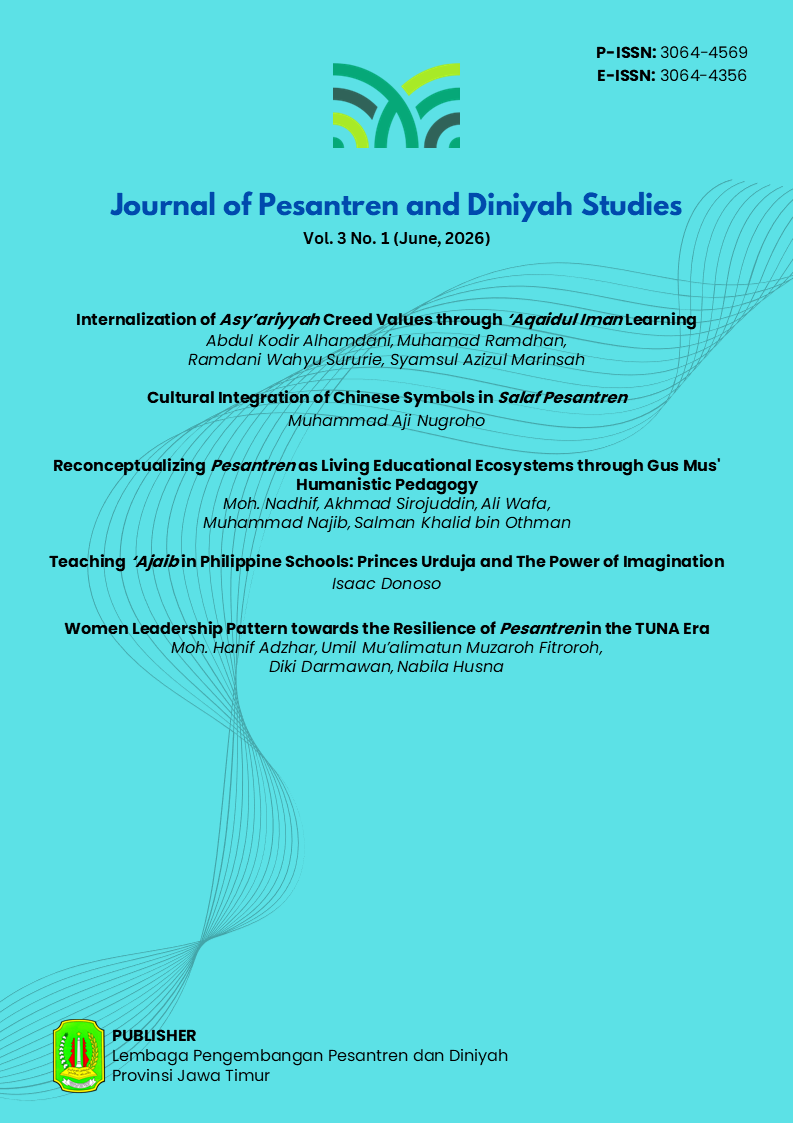
Women Leadership Pattern towards the Resilience of Pesantren in the TUNA Era
DOI:
https://doi.org/10.63245/jpds.v3i1.70Abstract
Pesantren face new challenges in the form of turbulent, uncertain, and novel changes, or the TUNA Era, which refers to an institutional condition characterized by turbulence, uncertainty, novelty, and ambiguity. This study aims to analyze how the leadership of Nyai Hj. Bariroh Aziz at the Al-Madienah Denanyar Pesantren in Jombang builds institutional resilience through the perspectives of self-agency and feminist ethics. This study employs a qualitative case study design. Data were collected through in-depth interviews, participatory observation, and document analysis, and then analyzed thematically through data reduction, coding, and case interpretation. The results indicate that Nyai’s leadership is built upon eight dimensions of self-agency: self-reflection, open communication, processing of experiences, the ability to make sound decisions, analysis of long-term benefits, care for oneself and the environment, consistent commitment, and a willingness to engage in continuous learning. These dimensions form a leadership style that is reflective, adaptive, inclusive, and oriented toward the common good, thereby strengthening the resilience of the pesantren without compromising its core values. This study expands the discourse on women’s leadership in pesantrens by demonstrating that women’s agency serves as a source of institutional resilience. Theoretically, self-agency and feminist ethics help explain how the authority, moral responsibility, and strategic decisions of female leaders contribute to institutional resilience amid uncertainty.
Keywords:
Feminist Ethics, Institutional Resilience, Self-Agency, TUNA Era, Women’s LeadershipReferences
Ahsan, Muhammad Nur, and Siti Aimah. “Penerapan Manajemen Mutu Terpadu Di Lembaga Pendidikan Swasta Islam: Resiliensi Terhadap Keterbatasan Anggaran.” Southeast Asian Journal of Islamic Education Management 6, no. 1 (2025): 21–36. https://doi.org/10.21154/sajiem.v6i1.395.
Ahwarumi, Biyati, and Tjiptohadi Sawarjuwono. “Enhancing Innovation Roles of Pesantren Business Incubator in Pondok Pesantren Sunan Drajat.” Journal of Innovation in Business and Economics 1, no. 02 (December 2017): 71. https://doi.org/10.22219/jibe.v1i02.4938.
Anggraeni, Dewi, Fitrotul Muzayyanah, and Gumilar Irfanullah. “Pola Kepemimpinan Nyai Masriyah Amva Terhadap Resiliensi Pesantren Di Era Pendemi Covid -19.” Hayula: Indonesian Journal of Multidisciplinary Islamic Studies 7, no. 1 (January 2023): 107–24. https://doi.org/10.21009/hayula.007.01.07.
Arief, Mohammad, and Ridhatullah Assya’bani. “Eksistensi Manajemen Pesantren Di Era Digital.” Al Qalam: Jurnal Ilmiah Keagamaan Dan Kemasyarakatan 16, no. 6 (February 2023): 2548. https://doi.org/10.35931/aq.v16i6.1541.
Asifudin, Ahmad Janan. “Manajemen Pendidikan Untuk Pondok Pesantren.” Manageria: Jurnal Manajemen Pendidikan Islam 1, no. 2 (2017): 355–66. https://doi.org/10.14421/manageria.2016.12-10.
Avolio, Bruce J., and William L. Gardner. “Authentic Leadership Development: Getting to the Root of Positive Forms of Leadership.” The Leadership Quarterly 16, no. 3 (June 2005): 315–38. https://doi.org/10.1016/j.leaqua.2005.03.001.
Bahri, Saiful. “Perspektif Teori Struktural Fungsionalisme Tentang Ketahanan Sistem Pendidikan Pesantren.” MIQOT: Jurnal Ilmu-Ilmu Keislaman 40, no. 1 (2016). https://doi.org/10.30821/miqot.v40i1.221.
Bedoui, Hichem E., and Walid Mansour. “Performance and Maqasid Al-Shari’ah’s Pentagon-Shaped Ethical Measurement.” Science and Engineering Ethics 21, no. 3 (2015): 555–76. https://doi.org/10.1007/s11948-014-9561-9.
Bennis, Warren, and Burt Nanus. Leaders: The Strategies for Taking Charge. Harper & Row, 1985.
Cascio, Jamais. “Facing the Age of Chaos.” Medium, 2020.
Creswell, John W., and Cheryl N. Poth. Qualitative Inquiry and Research Design: Choosing Among Five Approaches. 4th ed. SAGE Publications, 2018.
Eva, Nathan, Mulyadi Robin, Sen Sendjaya, Dirk van Dierendonck, and Robert C. Liden. “Servant Leadership: A Systematic Review and Call for Future Research.” The Leadership Quarterly 30, no. 1 (2019): 111–32. https://doi.org/10.1016/j.leaqua.2018.07.004.
Futaqi, S., and S. Mashuri. “Multicultural Leadership of Kiai for Managing Diversity in Indonesian Context: Spiritual, Intellectual, and Social Integration.” Cultural Management: Science and Education 6, no. 2 (2022): 57–73.
Habibah, Maimunatun, and Edi Nurhidin. “Profil Pelajar Dalam Kurikulum Merdeka Madrasah Di Era VUCA.” Intelektual: Jurnal Pendidikan Dan Studi Keislaman 13, no. 2 (September 2023): 211–30. https://doi.org/10.33367/ji.v13i2.4061.
Hasan, Dedy Haryadi, Almuhajir Almuhajir, and Mukhlisuddin Ilyas. “Soft Skills-Based Curriculum Implementation: A Response to Educational Challenges in the Vuca and Tuna Era.” JURNAL HURRIAH: Jurnal Evaluasi Pendidikan Dan Penelitian 6, no. 2 (June 2025): 886–93. https://doi.org/10.56806/jh.v6i2.259.
Hillmann, Julia, and Edeltraud Guenther. “Organizational Resilience: A Valuable Construct for Management Research?” International Journal of Management Reviews 23, no. 1 (January 2021): 7–44. https://doi.org/10.1111/ijmr.12239.
Istiqlaliyani, Fikriyah. “Ulama Perempuan Di Pesantren: Studi Tentang Kepemimpinan Nyai Hj. Masriyah Amva.” Jurnal Educatio FKIP UNMA 8, no. 1 (January 2022): 104–9. https://doi.org/10.31949/educatio.v8i1.1670.
Jaggar, Alison M. “Feminist Ethics.” In The Blackwell Guide to Ethical Theory, 433–60. Wiley, 2013. https://doi.org/10.1111/b.9780631201199.1999.00022.x.
Kirana, Zuyyina Candra. “Adaptasi Tradisi Kearifan Pesantren Dalam Pendidikan Modern.” Salimiya: Jurnal Studi Ilmu Keagamaan Islam 2, no. 4 (2021): 45–59. https://doi.org/10.2906/salimiya.v2i4.476.
Kuvaini, A., A. Hidayat, C. Kusmana, and S. Basuni. “Institutional Resilience of Pesantren in Mangrove Forest Management in Kangean Island, East Java Province, Indonesia.” Aquaculture, Aquarium, Conservation and Legislation 10, no. 6 (2017): 1475–82.
Laila, Rika Fadilatul, and Nur Ittihadatul Ummah. “Manajemen Kurikulum Program Muadalah Kulliyatul Muballighien Al-Islamiyah (KMI) Di Pondok Pesantren Al-Ishlah Bondowoso.” Jurnal Manajemen Dan Pendidikan Agama Islam 3, no. 1 (2024): 168–75. https://doi.org/10.61132/jmpai.v3i1.844.
Larasati, Zu’ama Anggun, Subhi Nur Ishaki, Rikky Triolin Saputra, Chairul Anwar, Syaiful Anwar, and Wasehudin Wasehudin. “Problematika Pendidikan Agama Di Pondok Pesantren.” DIKSI: Jurnal Kajian Pendidikan Dan Sosial 6, no. 2 (June 2025): 146–56. https://doi.org/10.53299/diksi.v6i2.1620.
Latifah, Hilmiyatul, and Hasyim Asy’ari. “The Role of Women’s Leadership in the Development of Islamic Education Management.” Thawalib: Jurnal Kependidikan Islam 5, no. 2 (October 2024): 463–72. https://doi.org/10.54150/thawalib.v5i2.486.
Lopes Cardozo, Mieke T. A., Rizki Amalia Affiat, Faryaal Zaman, Maida Irawani, and Eka Srimulyani. “Silent Struggles: Women Education Leaders’ Agency for Peacebuilding in Islamic Schools in Post-Conflict Aceh.” Journal of Peace Education 19, no. 2 (May 2022): 158–81. https://doi.org/10.1080/17400201.2022.2052826.
Meyers, Diana Tietjens. Gender in the Mirror: Cultural Imagery and Women’s Agency. Oxford University Press, 2002.
Miles, Matthew B., A. Michael Huberman, and Johnny Saldana. Qualitative Data Analysis: A Methods Sourcebook. 3rd ed. California: Sage Publications, 2014.
Misbah, Ahmad. “Model Manajemen Keuangan Syariah Di Pesantren: Meningkatkan Kemandirian Ekonomi Lembaga Pendidikan Islam Di Era Digital.” Nidhomiyyah: Jurnal Manajemen Pendidikan Islam 5, no. 2 (July 2024): 166–84. https://doi.org/10.38073/nidhomiyyah.v5i2.1940.
Muthohirin, Nafik, and Suherman Suherman. “Resiliensi Pesantren Terhadap Ekstrimisme Kekerasan Berbasiskan Agama Dan Implikasinya Terhadap Masyarakat Pesisir Lamongan.” J-PAI: Jurnal Pendidikan Agama Islam 7, no. 1 (December 2020). https://doi.org/10.18860/jpai.v7i1.11887.
Ni’am, Shokhibun, and Nawal Nur Arafah. “Transformasi Sistem Pendidikan Formal Pesantren.” DIMAR: Jurnal Pendidikan Islam 6, no. 1 (December 2024): 69–84. https://doi.org/10.58577/dimar.v6i1.271.
Paisun, Paisun, Maskuri Maskuri, and Junaidi Mistar. “The Kiai’s Leadership in Harmonizing Chinese-Muslim Relations through Multicultural Islamic Education.” Munaddhomah: Jurnal Manajemen Pendidikan Islam 6, no. 2 (June 2025): 329–44. https://doi.org/10.31538/munaddhomah.v6i2.1897.
Patton, Michael Quinn. Qualitative Research and Evaluation Methods: Integrating Theory and Practice. 4th ed. SAGE Publications, 2015.
Ramirez, Rafael, and Angela Wilkinson. Strategic Reframing: The Oxford Scenario Planning Approach. Oxford University Press, 2016.
Sagala, Syaiful. “Manajemen Dan Kepemimpinan Pendidikan Pondok Pesantren.” Jurnal Tarbiyah 22, no. 2 (2015). https://doi.org/10.30829/tar.v22i2.37.
Sarid, Ariel, and Maya Levanon. “Embracing Dualities: Principles of Education for a VUCA World.” Educational Philosophy and Theory 55, no. 12 (October 2023): 1375–86. https://doi.org/10.1080/00131857.2022.2162384.
Stake, Robert, and Merel Visse. Case Study Research. Springer, 1995.
Suprapto, Savira Annisa Putri. “Pengaruh Religiusitas Terhadap Resiliensi Pada Santri Pondok Pesantren.” Cognicia 8, no. 1 (March 2020): 69–78. https://doi.org/10.22219/cognicia.v8i1.11738.
Syamsir, Syamsir, Nika Saputra, and Rizki Afri Mulia. “Leadership Agility in a VUCA World: A Systematic Review, Conceptual Insights, and Research Directions.” Cogent Business & Management 12, no. 1 (December 2025): 2482022. https://doi.org/10.1080/23311975.2025.2482022.
Downloads
Published
Issue
Section
License
Copyright (c) 2026 Moh. Hanif Adzhar, Umil Mu’alimatun Muzaroh Fitroroh, Diki Darmawan, Nabila Husna (Author)

This work is licensed under a Creative Commons Attribution-ShareAlike 4.0 International License.